Police in eastern India have opened a criminal investigation into the disappearance of an official report on the killing of about 100 Christians and the destruction of hundreds of church buildings in 2008.
The report has vanished from the Odisha state Chief Minister’s Office, and no government has yet explained when or how.
The Justice A.S. Naidu Commission report examined the causes of the 2008 violence in Odisha state’s Kandhamal District, widely regarded as the worst episode of anti-Christian persecution in India’s history. It was submitted to the Odisha government in December 2015 and was never made public.
A second missing report, from a separate inquiry into a 2016 hospital fire that killed 22 people in Bhubaneswar, the state capital, has disappeared alongside it.
Sarat Chandra Marandi, a joint secretary in Odisha’s Home Department, on June 10 filed a complaint at the Capital Police Station in Bhubaneswar, stating that both reports are missing from the Chief Minister’s Office (CMO).
According to the complaint, the Naidu Commission report was sent from the Home Department to the CMO through the office of Odisha state’s Chief Secretary on Sept. 19, 2016. The hospital fire report followed on May 24, 2018. Both moved through routine government channels.
The complaint points to one date in particular: June 4, 2024, the day vote counting confirmed that the Hindu nationalist Bharatiya Janata Party (BJP) had defeated the secular Biju Janata Dal (BJD), ending the BJD’s unbroken 24-year hold on Odisha. Other files the Home Department had sent to the CMO were returned that same day. The two commission reports were not, and have not surfaced since.
“The circumstances surrounding the disappearance of these two reports, particularly when other files forwarded during the same period were returned, create a reasonable suspicion that the reports may have been intentionally removed, retained, concealed, destroyed or otherwise unlawfully dealt with,” Marandi’s complaint states.
Police registered the case under multiple sections of the Bharatiya Nyaya Sanhita (BNS), India’s criminal code, covering theft of official documents, criminal breach of trust by public servants, and causing the disappearance of evidence. The complaint became a First Information Report (FIR), the document that formally opens a criminal case in India, the same day it was filed.
A Special Investigation Team (SIT) has since been formed under the Twin City Police Commissioner, with a Superintendent of Police and two inspectors. The team has questioned Marandi, examined records, and begun scanning CCTV footage and electronic data for any trace of the missing files.
Kandhamal is a remote, largely tribal and Dalit district in central Odisha. According to the 2011 Census, Hindus make up about 79 percent of its roughly 733,000 residents and Christians about 20 percent, a figure Hindu nationalist groups have long cited as evidence of mass religious conversion.
Christian leaders and demographic researchers dispute that reading. They trace it instead to an administrative decision: Kandhamal was carved out of the larger Boudh-Kandhamal District, then called Phulbani, in 1994, and the new boundary concentrated almost the entire Christian population on one side of the split. One demographic study found the Christian share was just over 11 percent in the undivided district before 1994, climbing to about 18 percent in the new Kandhamal District while falling to under 1 percent in Boudh, the district created alongside it.
Critics argue this redrawing of borders, not a wave of conversions, accounts for much of Kandhamal’s rising Christian share in the decades since.
Report Contents
On Aug. 23, 2008, Hindu seer Swami Laxmanananda Saraswati was shot dead at his ashram, a religious retreat, in Kandhamal. Maoist rebels later claimed responsibility for the killing, but Hindu nationalist groups blamed Christians instead and turned on them.
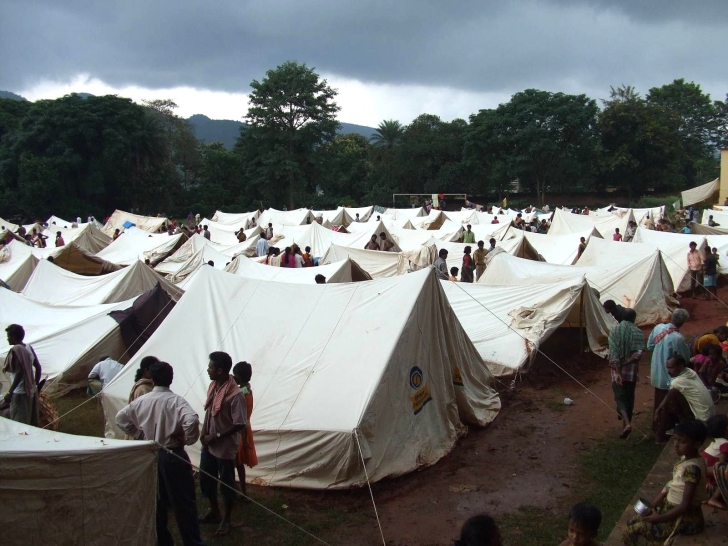
Christians did not retaliate. For nearly seven weeks, mobs moved through Kandhamal’s villages. According to church and human rights organizations, about 100 Christians were killed, hundreds of church buildings were destroyed, more than 5,600 homes were burned or looted, and more than 56,000 people were displaced. Women were raped. Thousands were pressured under threat of violence to undergo Hindu reconversion ceremonies.
A fact-finding team from the Communist Party of India (Marxist-Leninist) reported a far higher toll, citing an anonymous government official of the state, then known as Orissa state, who said more than 500 people had died and that he had personally authorized the cremation of at least 200 bodies. The figure was never officially confirmed.
It was not the district’s first brush with communal violence. An earlier wave struck Kandhamal in December 2007, after bodyguards of Saraswati assaulted Christians and damaged church property during a Christmas celebration; Saraswati then said Christians had attacked him, a claim eyewitnesses and medical reports disputed at the time. At least three people were killed, and more than 100 churches and roughly 700 houses were destroyed.
Veteran Indian human rights commentator John Dayal, who has tracked Kandhamal for nearly two decades, told Christian Daily International he holds a strong suspicion that the violence was deliberately engineered. In earlier writing, he described a threat letter, which he says was shared with him by state intelligence officials and attributed to Maoist sources, naming Saraswati as the “mastermind” behind it.
The commission meant to investigate the 2008 violence did not begin with Justice Naidu. It was first entrusted to Justice Sarat Chandra Mohapatra, a retired Orissa High Court judge, who spent years gathering evidence before his death in 2012. The state government then appointed Justice Naidu to complete the inquiry, and he submitted the final report, spanning nearly 2,000 pages across two volumes, in December 2015. It was never released.
Archbishop John Barwa of the Cuttack-Bhubaneswar Archdiocese, whose territory includes all of Kandhamal District, told Christian Daily International that the united church leadership had pushed for years to have the report published.
“The Church and the archdiocese have consistently desired that the Naidu Commission report be made public,” Barwa said. “Representations and appeals were made at different levels, because the Christian community believed that truth should not remain hidden. Unfortunately, the report was never released. We always maintained that publication of the report would help healing, accountability, and public confidence.”
For Kandhamal’s Christians, he said, the report’s purpose went well beyond a bureaucratic record.
“The people of Kandhamal hoped the report would establish the truth: what happened, why it happened, who failed in their duty, and how such violence could be prevented in future,” Barwa said. “For survivors and families of those killed, the missing report is not merely a missing file; it is a painful delay in truth and closure. Yet their hope for justice has not disappeared.”
On the investigation, Barwa was measured.
“The Church welcomes any lawful and sincere investigation,” he told Christian Daily International. “We do not want to view it only through a political lens. Our concern is truth, justice, peace, and accountability. If the SIT works independently, fairly and transparently, it can restore public confidence and help the victims.”
Is justice still possible after 17 years?
“Yes, justice is still possible, even after 17 years,” he said. “Justice today means truth being made public, responsibility being fixed, innocent victims being acknowledged, proper compensation and rehabilitation, protection of religious freedom, and assurance that such violence will never happen again. For the Christian community, justice is not revenge; justice is truth, dignity, healing, and peace.”
‘Deeply Alarming’
The Rev. Ajay Kumar Singh, a Catholic priest and human rights advocate who has worked with Kandhamal survivors for years, called the report’s disappearance “deeply alarming” when it first came to light.
He described the 2008 violence as what he considers the largest such violence against Christians in India in the last 300 years.
Singh said the manner of the report’s loss compounds the concern.
“The Commission is said to have produced only one hardbound copy,” he told Christian Daily International. “This raises serious apprehensions about possible tampering with the soft copy to suit propaganda. Any possibility of manipulation, misinformation, or distortion of facts is a matter of grave concern for the community.”
Survivors carry deep skepticism toward the commission process itself, rooted in years of feeling pre-judged, he said.
“The community sees foul play in this,” Singh said. “The survivors had boycotted the Panigrahi and Mohapatra Commissions, as both had blamed conversion as the root cause of the violence even before making their reports public. The communities, therefore, chose not to participate voluntarily, citing bias in the commissions. The survivors have little expectation of fairness in the Commission’s report.”
He added that only those specifically summoned testified before the panel, leaving many survivors’ accounts unrecorded.
Singh did not spare either of Odisha’s major parties.
“The Commission has become a weapon of political propaganda,” he told CDI. “Even the BJD government did little to deliver justice to the Kandhamal victims. It failed to reopen the closed cases despite directions from the Supreme Court. The actual victims continue to suffer, and now face further hardship amid the propaganda of the present government as well.”
His reference to the Supreme Court is borne out by the record: In 2016, acting on a petition from the late Archbishop Raphael Cheenath, the court ordered the reopening of more than 300 Kandhamal cases that police had closed prematurely.
The Rev. Vijayesh Lal, general secretary of the Evangelical Fellowship of India (EFI), the country’s umbrella body for evangelical Christians, said the disappearance has reopened old wounds for many Kandhamal survivors.
“We do not wish to prejudge the investigation or assign motives where facts are still being established,” Lal said. “Nearly 18 years after the violence, survivors are still waiting for a full accounting of what happened.”
The disappearance of a judicial commission report is therefore not merely an administrative concern, but risks undermining confidence that the suffering of victims has been treated with the seriousness it deserves, he said.
“Reports can be misplaced,” Lal said. “The suffering of victims must not be.”
Lal said EFI welcomes any sincere, lawful effort to recover the report, but that it would be premature to speculate about political motivations behind the Special Investigative Team. Its credibility, he said, “will ultimately be measured by whether the facts are established, responsibility is identified according to law, and public confidence is restored.”
He said the stakes extend well beyond Kandhamal.
“Communities affected by violence need to know that their suffering matters, that it will be remembered, and that the institutions of the State will preserve an honest record of what occurred,” he said. “A democracy owes victims more than sympathy. It owes them truth. That is why this case matters far beyond Kandhamal.”
‘A Real Danger’
Dayal was more direct in assigning blame, while framing much of it as suspicion rather than established fact.
He noted that Odisha’s then-chief minister told the state Assembly that those responsible for the 2008 violence belonged to the Sangh Parivar, a family of Hindu nationalist organizations, particularly the Bajrang Dal, a Hindu nationalist youth organization, and said it stood to reason the commission’s own findings reflected this.
“It is my strong suspicion that the report was deliberately not tabled for many years after it was submitted and has now effectively vanished,” Dayal said. “I fear that mischief may have been done by the current political regime, possibly to gain access to the report and alter it to suit political interests before its release.”
He called for a central investigation, possibly by India’s National Investigation Agency, arguing that “the truth must be preserved and not falsified.”
Dayal said the pattern extends beyond Odisha.
“Similar concerns have arisen in states such as Chhattisgarh and Madhya Pradesh,” he said. “In cases of communal or targeted violence, the full truth often never emerges.”
He argued that police stations, district administrations and lower courts need closer scrutiny from High Courts and other independent authorities, with consequences for officials who falsify records or stall investigations.
Dayal situated the missing report within a longer political history. The BJP was still a coalition partner in the BJD-led state government when the 2008 violence broke out, and in Dayal’s account, the violence helped polarize the state and laid groundwork for the BJP’s later growth in Odisha, with Sangh-affiliated groups holding real sway over the law-and-order machinery at the time. By his estimate, the violence displaced approximately 75,000 people and emptied more than 400 villages of Christian presence, figures that differ from the lower estimates cited by some church and rights organizations.
Dayal said it remains difficult to fully absolve either party of responsibility: the BJD for what happened on its watch and in the years of delay that followed, the BJP for the role of its affiliated organizations in the violence itself. For Kandhamal’s Christians, he suggested, the fight between the two parties over who lost a report has become one more way their suffering is used rather than addressed.
“There is a real danger that political competition between the BJP and the BJD will overshadow the central issue,” he said: “justice, accountability, and healing for the victims of Kandhamal.”
Political Back-and-Forth
The disappearance first became public after Law Minister Prithiviraj Harichandan alleged the reports had gone missing under the BJD government. Chief Minister Mohan Charan Majhi promised a full investigation, and Revenue Minister Suresh Pujari pledged the government would publish the reports once recovered.
The BJD pushed back, with former MP Munna Khan asking why a government already two years in office was raising the alarm only now, and Congress leader Ramachandra Kadam pressing for a fuller account of the delay. Former Chief Secretary Bijay Patnaik offered one note of hope: Odisha’s digital file-tracking system, adopted around 2012-2013, may still hold electronic copies even if the originals do not.
For Odisha’s Christian community, the dispute between two political parties over who lost the report is unlikely to feel like the point. The accountability that survivors have sought since 2008, and before that in 2007, has rarely moved according to anyone’s timeline but the state’s.
The Naidu Commission was supposed to give Kandhamal’s Christians something they have not yet received in 17 years: an official, public account of what was done to them, and why it was allowed to happen. Whether that account still exists, in any form, is now itself the subject of a police investigation.
The Special Investigative Team’s inquiry continues. No timeline for its conclusion has been announced.