
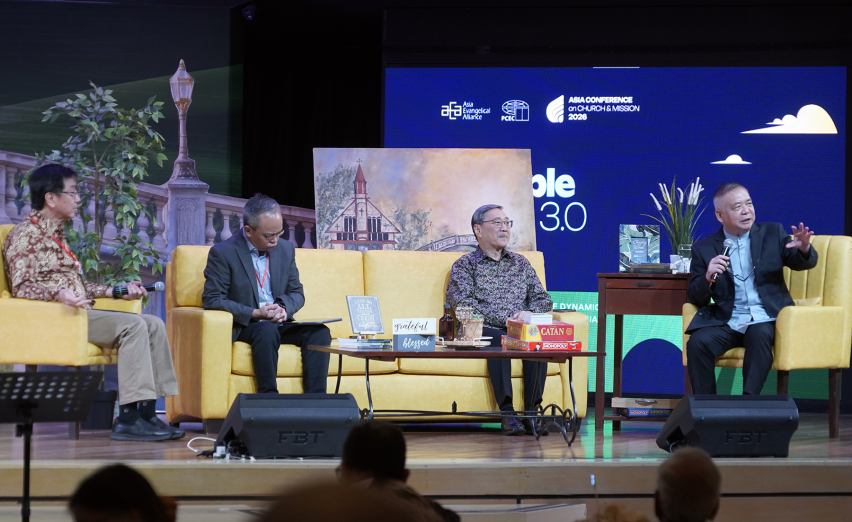
On the third and final day of the Asia Conference on Church & Mission, three church leaders from across Asia called evangelical congregations and denominational networks to stop measuring ministry success by attendance figures and program activity, arguing that the global church's failure to prioritize discipleship has produced a generation of spiritually shallow Christians — and that only a deliberate, relational, and intergenerational approach to disciple-making can reverse it.
The morning panel, held Thursday, June 11, at GCF South Metro in Alabang, Metro Manila, featured Rev. Dr. Lito Villoria, Senior Pastor of GCF South Metro and Executive Chairman of the Philippines' National Disciple-making Campaign Committee; Dr. John M. Chandra, Senior Pastor and Synod Chairman of Gereja Pantekosta Kharismatika di Indonesia (GPKDI); and Rev. Edmund Chan, Founder of the Global Alliance of International Disciple Making Churches and Leadership Mentor at Covenant Evangelical Free Church in Singapore. The session focused on how churches, denominations, and national alliances can move from event-based ministry to intentional, measurable disciple-making.
ACCM 2026, organized by the Asia Evangelical Alliance in partnership with the Philippine Council of Evangelical Churches (PCEC), has gathered 210 delegates from 25 nations under the theme "Disciple or Die 3.0" — the third in a series of gatherings since the AEA's 2024 general assembly in Mongolia first sounded the alarm over the state of discipleship across the continent.
Providing a pathway to transition to disciple-making
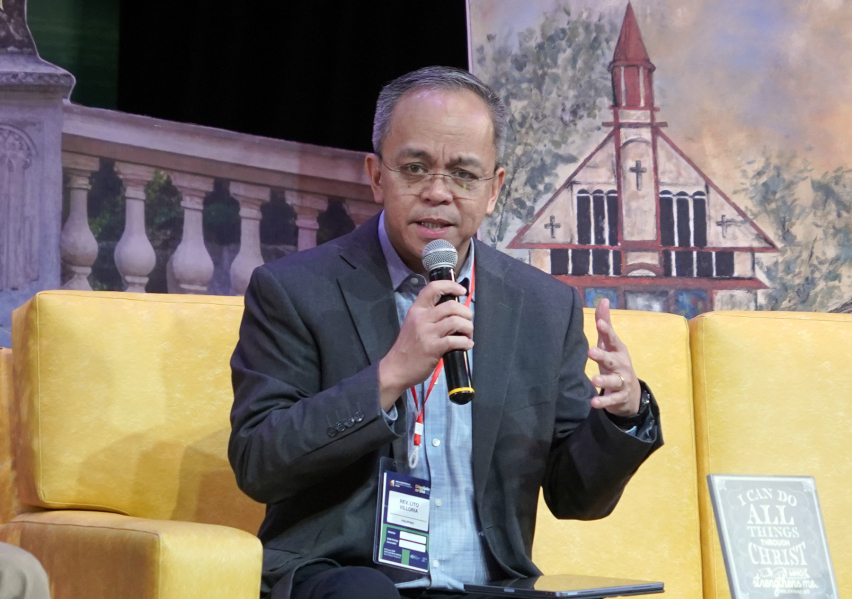
Villoria, who is part of the leadership of the Philippine Council of Evangelical Churches (PCEC) representing 92 denominations, opened by naming what he described as the central challenge with national alliances: talking about disciple-making without giving churches a workable path to practice it.
"Many churches, even denominations and leaders, are talking about disciple making and discipleship, but it is not really getting traction at the church level," he said. "So that is the challenge."
He outlined four practices a national alliance must stop if it is serious about change. The first is treating disciple-making as a conference activity and “just do the same conferences of inspiring the churches, but not really providing them a pathway on how they can be disciple-making churches," he said. Second, success can no longer be measured only in attendance and events. "We need to ask ourselves: are disciples being formed? Are disciples discipling others? Are they growing toward spiritual maturity?"
Third, Villoria argued, alliances must stop assuming pastors already know how to lead this kind of transition. And fourth, national alliances cannot function only as coordination platforms. "Coordination is helpful, but coordination alone will not produce disciple-making churches." Agreement that discipleship matters is not enough, he said — what is needed is alignment, which he defined as actually restructuring the life of a congregation around the mandate to make disciples. "It's difficult. It requires culture change and it will take time."
For the PCEC specifically, Villoria described four commitments. The first is maintaining a clear biblical vision — consistently communicating that multiplying disciples is not one agenda item among many but the central one. The second is aligning national strategy with measurable outcomes: tracking how many denominations are taking concrete steps, how many churches have a defined discipleship pathway, how many individuals are in a small group and actively discipling others. The third is working through the alliance's 92 member denominations, regional networks, and theological institutions. The fourth, he said, is the most foundational: the whole movement must be sustained by prayer.
"A disciple-making movement cannot be manufactured by strategy alone," Villoria said. "Strategies are needed, structures are helpful, training is necessary — but only the Holy Spirit can revive the church, transform the hearts, and empower ordinary believers to make disciples."
New metrics to keep community “on fire for discipleship”
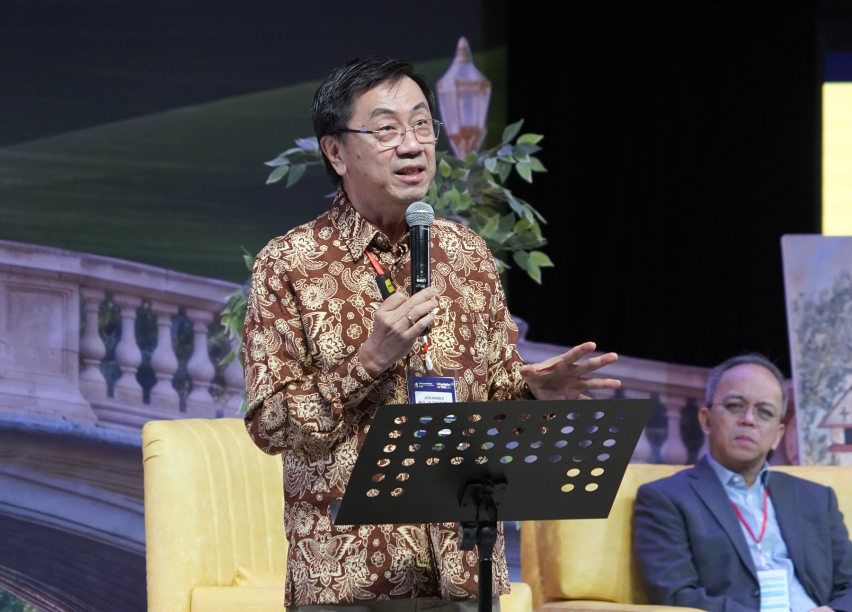
Chandra, who has served as a pastor in Indonesia for 36 years, offered an honest account of his own journey toward recognizing what he called the shallowness of information-heavy ministry.
"I'm just teaching them — informing them," he said of his earlier approach. "But I would like to go deeper." After three decades of preaching, he came to see that equipping disciples requires more than classroom time or biblical content transferred at scale. Discipleship, he argued, must be understood as the purpose of the church's existence — not one program among many.
Chandra named five habits he believes churches must abandon. The first is focusing solely on evangelism without discipleship. "We have to make sure we just want to reach, but also make disciples of God." The second is associating discipleship with information transfer alone. The third is treating discipleship as a program rather than the defining purpose of church life. The fourth — and what he described as the hardest — is failing to build genuine relationships. "If you ask me what is the hard thing I have to learn when transforming my church and denomination, it is how to build relationships." The fifth is accumulating disciples without deploying them.
Three years into the transition at his own congregation, Chandra described removing the traditional weekly attendance count from the board. "We count the offering that comes in from the service — but let's count how many people we can serve to become disciples," he said. The new metric, he explained, keeps the community "on fire for discipleship."
At the denominational level, Chandra said he began by discipling six pastors personally — deliberately small, deliberately slow. "I learned from Jesus: he discipled 12," he said. "I started with six." Each of those pastors now disciples others, and the pattern is beginning to multiply through GPKDI's network of churches across nine provinces in Indonesia. By May 2029, he said, the denomination has set a goal of seeing 50 percent of its local churches become disciple-making churches — defined as congregations where at least 30 percent of members are actively discipling others.
The framework guiding the movement, he said, is built around four values he described with the acronym REAL: Relationship first, Empowered by the Word, Authentic and accountable, and Life transformation as the expected result.
Hope for the global Church is not in the masses

Chan closed the panel with what he described as a view from the broader horizon — data on the condition of the global church that he said demands a response.
Citing figures from a Pew Report, Chan said there are approximately seven million churches worldwide. Of those, four million are stagnant — neither growing nor making disciples. Two million are in decline, with Europe as a particular example, where former church buildings are being repurposed for other uses. Only one million, he said, are growing — and not all of them in healthy ways. Annual growth of Christianity globally stands at approximately 1.8 percent, he noted — a figure he called very low.
"This is the state of the globe," he said.
Chan described a gathering of approximately 400 Christian leaders in Louisiana late last year, convened to pray and deliberate over how to reverse those trends. The initiative broke into 30 working groups. One conclusion surfaced consistently across all of them: discipleship is the key.
"If we are committed to this focus, we need discipleship — healthy discipleship for healthy churches," Chan said.
He argued that the core deficit is not resources or strategy but a specific kind of leadership. He distinguished between what he called weak leaders, who lack both knowledge and skill; good leaders, who have those but lack resilience when tested; and strong leaders, who persevere through opposition. The greatest need in the church today, he said, is not strong leaders — it is wise leaders. "For wisdom-based leadership, we must come back to the sacred Scriptures and the foundations of the church so that there are healthy, godly leaders who lead wisely."
Chan offered three anchors for that kind of leadership: reestablishing the Lordship of Jesus Christ, refocusing on spiritual maturity as the goal rather than programs or growth metrics, and committing to spiritual multiplication — investing deeply in a few rather than broadcasting to many.
He illustrated the point with an account from a bishop he has been mentoring, who entered a discipleship journey in 2019 after years of fruitful public ministry but, by his own account, a private experience of spiritual emptiness. "People viewed me as doing well — having vision, having a lot of spiritual gifts," the bishop said, according to Chan. "What people did not realize was that I was feeling spiritually empty." After going through a discipleship program, the bishop recruited four senior pastors, then 12 lay pastors, organizing them into small groups of no more than five pastoral couples. The pattern spread. Eventually, he was mentoring five cohorts of seven bishops each — 35 bishops in total — and the approach had been adopted as the diocesan standard through 2030, spreading to all 165 dioceses in the country.
"One man, changed by the Lord, came under the authority and lordship of Jesus, passed it on — and God lodged a movement," Chan said.
His closing word to the assembled delegates echoed the conference's emphasis on depth over scale. "Hope for the global church is not in the masses," he said. "Jesus did not invest himself in the masses. He invested in a few. Continue to minister to the masses — but invest."
ACCM 2026 concludes Friday, June 12, with a joint session bringing together the conference delegates and an estimated 1,000 Filipino pastors for a focused intensive on intentional disciple-making.








